- Home
- >
- Activities
- >
- The Gallery of the New University – Faculty of Slovenian and International Studies
- >
- Exhibitions
- >
- Archive
- >
- 19th Exhibition of paintings by Igor Banfi: New paintings
19th Exhibition of paintings by Igor Banfi: New paintings
Igor Banfi: New paintings
Despite the thematic and multifaceted diversity that characterizes contemporary art, landscape — this exceptionally popular, interpretatively and semantically open theme — still often appears on painters’ canvases. The works presented here once again connect us with the features and qualities of the landscape, but also with humankind and with the structures created within it.
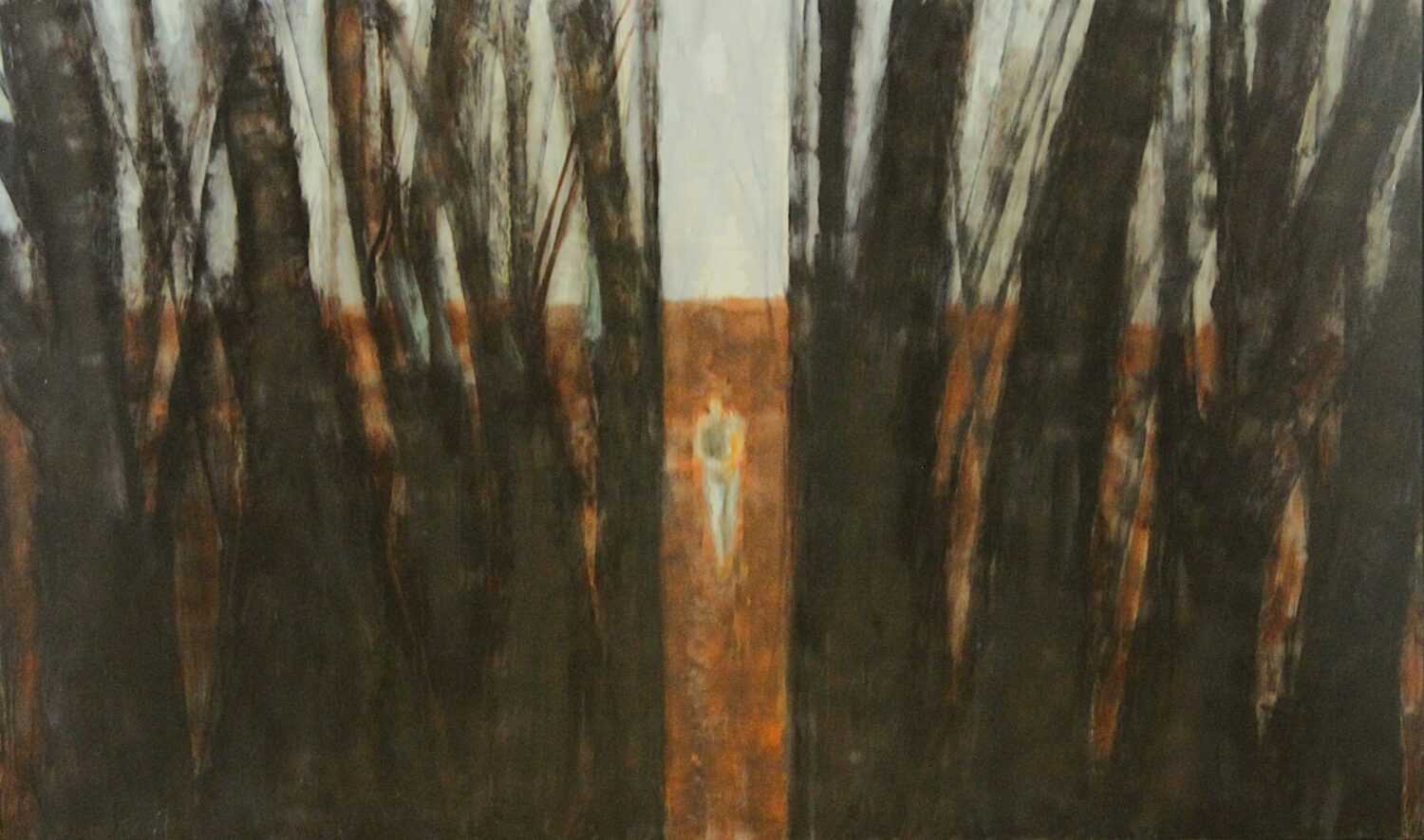
In Igor Banfi’s pictorial language, the tree, water, human figure, and house do not appear in an illustrative role but as archetypal signs that conceal the deeper meanings of the artist’s personal landscape. This landscape is open: with its sparse, ascetic, and carefully chosen narrative and its palette immersed in earthy tones, it evokes calmness — at times melancholy, yet always meditative. The artist distances himself from the classical beauty of nature and does not create a realistic landscape, much less a universal image of it. Although certain elements of his native Pannonian environment can be found within, Banfi does not reproduce or construct the external world. His journey home is a journey inward, into a space of meaningful reflection, self-questioning, awareness, and feeling. His landscapes are paysages de l’âme — landscapes of the soul. They mirror the artist’s experiences, searches, and states of being. The paintings are deeply introspective, a meditative and psychological space reflecting the surface of the artist’s soul. Each form, each brushstroke becomes a bearer of silence, melancholy, and memory — in which, despite the currently darker tones, light, warmth, and serenity persist.
Just as life changes, so too does Banfi’s intimate iconographic scheme. Some protagonists remain, others depart. In his most recent works, the house appears as a new motif, and a notable change lies in the uniting of several archetypal elements within a single composition. As a result, there is less empty space, yet still enough for the paintings to retain their purity and even minimalism, offering “space” for the artist’s withdrawal, for his quiet, unspoken yet sensed thoughts, and for the viewer’s escape into another, pictorial reality. The compositional structure still gravitates toward a horizontal orientation, with the shoreline forming the horizon. Water, which serves as a mirror, allows reality and its reflection to meet, raising the question of which part of the image is more real — and what lies beyond the mirror: another world or merely its reflection. With its purifying power, water also holds other symbolic meanings.
The archetype of the artist’s perception, contemplation, and painterly expression remains Monk by the Sea, one of the most renowned works of the German Romantic painter Caspar David Friedrich, which already anticipates modernism. Together with the monk, Banfi travels through his inner landscapes, revealing an intimate perception of life. He entrusts his thoughts, awareness, and feelings entirely to the human figure — rendered in silhouette, indistinctly articulated, small, and in some cases slightly bent. More spiritually present than physically embodied, the figure remains such whether crossing a glowing yellow field toward a dark forest or appearing in the background, emerging from the woods. The artist also places the figure beside a house, which in one painting appears even too small to contain it, yet the painter’s conception of the architectural element as a symbol of home, shelter, safety, and warmth remains unchanged. His figure walks on water, biblically and metaphorically, or is joined with a tree. The tree is another of the artist’s favored elements, introducing a meaningful vertical into the horizontal structure. In the past, it appeared mostly as a solitary figure; today, several trees appear, their form now recalling cypresses.
The quiet traces of existence that the artist establishes in his compositions transform, in visual terms, into decisive and recognizable gestures. His brushstroke is broad, shaping an essence that is stylized and abstracted. Through it, the artist erases details, veils them, and constructs the image in multiple layers. In the painting Coming Home, the background is created spontaneously, and the paint that runs down the surface evokes a rainy atmosphere with vivid microstructural events. The layers of pigment are characteristically diverse — the materially dense are accompanied by translucent, glazelike applications, as if the painter sought to objectify his concerns, his philosophy, the eternal dialogue between the material and the spiritual, the visible and the invisible. These glazes are so revealing that they expose the “skin” of the canvas itself, allowing the elemental structure of the fabric to breathe. The facture is pronounced, and the surface seems not merely a bearer of the image but a part of its very content.
The color palette establishes a calm, intimate atmosphere. It is limited, reduced mainly to earthy tones, while the newer works feature more darkness. The restrained color concept is enriched by refined nuances and sensitive tonal ranges. The color gains full meaning only when considered in relation to the artist’s wish to create a spiritual atmosphere, or when understood as the chromatic impressions he summons onto the canvas from his life, his memories, and his current states of mind. In the spirit of life’s eternal analogies, there is also the confrontation of light and darkness. Without an identifiable source, light flows laterally across the pictorial field or gathers in the glow of the moon.
The creative identity of Igor Banfi — one of the most significant Slovenian painters of the middle generation — is recognizable and steadfast, yet open to formal and thematic evolution, oriented toward maturation. His pictorial language manifests itself fully and confidently on both large and small formats alike. In each, the figure lives — and in both, it has ample space. On large canvases, Banfi is a sovereign creator who gives meaning even to emptiness; on small ones, he is never constrained. He is always a master of his craft. He consistently offers variations on his chosen compositional structure of the landscape, on the silhouetted human figure, and on the carefully selected elements from his repertoire of archetypal interests. He always conjures that distinctive atmosphere — characteristic of his works — which transcends this particular space and time. Through it, thought may travel. And in the silent dialogue that surpasses words, artist and viewer may meet.
Anamarija Stibilj Šajn, Art Critic
About the author
Igor Banfi was born in 1973 in Murska Sobota. He studied painting at the Academy of Fine Arts and Design in Ljubljana, where he graduated in 1997 under the supervision of Prof. Andrej Jemec. He completed his postgraduate studies in 2000 under the mentorship of Prof. Lojze Logar. He is a member of the Society of Visual Artists of Prekmurje and Prlekija, as well as the Association of Slovenian Fine Arts Societies. Since 2000, he has held the status of independent creator in the field of culture.
He has presented his artworks in numerous solo and group exhibitions both in Slovenia and abroad, including the Maribor Art Gallery, Murska Sobota Gallery, Božidar Jakac Gallery in Kostanjevica na Krki, Lendava Castle, Pilon Gallery in Ajdovščina, and in Ljubljana at the ZDSLU Gallery, Bežigrad Gallery, Lek Gallery, and Družina Gallery.
He has also frequently participated in group exhibitions featuring artists from Prekmurje and in various art colonies. Leading Slovenian art critics have written about his painting. Igor Banfi lives and works in Ljubljana and Murska Sobota.