- Home
- >
- Activities
- >
- The Gallery of the New University – Faculty of Slovenian and International Studies
- >
- Exhibitions
- >
- Exhibition of paintings by Zoran Durbić: Imprints of inner images
Exhibition of paintings by Zoran Durbić: Imprints of inner images
Zoran Durbić is an academically trained painter, conservator-restorer, and printmaker who lives and works in Zagreb. Alongside his diverse artistic interests, he has placed the graphic medium at the center of his artistic practice since the early 1980s. With a unique body of work that represents an elixir of artistic and life energy, he elevates printmaking to the very pinnacle of contemporary visual art production in Croatia, while also being firmly established within the broader international art scene.
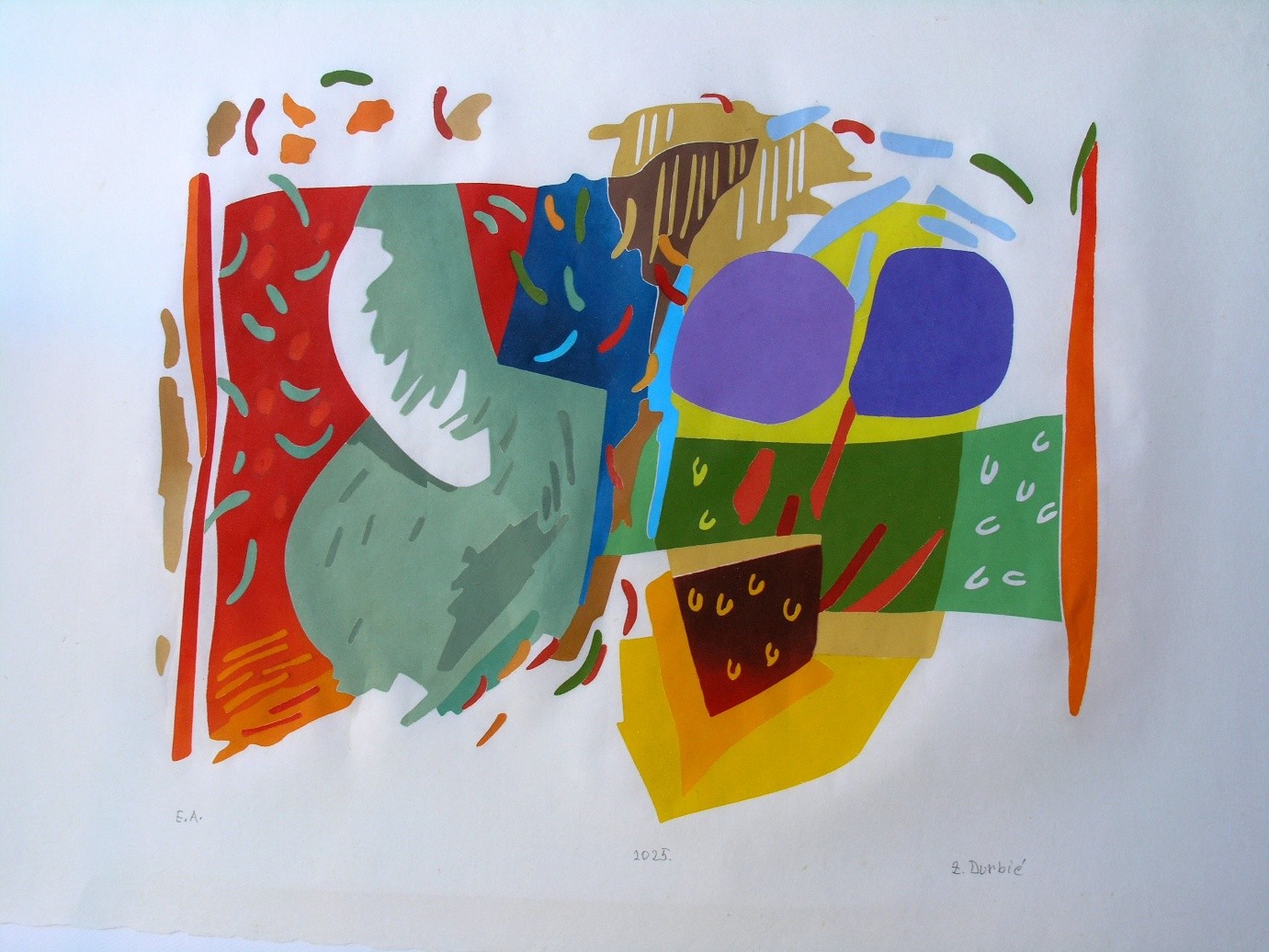
With a selection of graphic works, he comes to Ljubljana, the city where the Ljubljana Biennial of Graphic Arts was founded in 1955. Through this event, the city anchored itself on the global map and became an important part of one of the world’s oldest biennial art manifestations. Unfortunately, the most recent editions of this long-standing and illustrious event no longer grant classical artistic printmaking a central role. Durbić’s exhibition at the Gallery of the New University, however, brings precisely this “good old classic,” rooted in the technique of relief printing, particularly woodcut and linocut. The exhibited works reinforce the autonomy of this medium and testify to an exceptional level of authorial originality and expressive power. Using both graphic techniques—which first require the precise and meticulous preparation of the matrix, followed by careful printing—Durbić creates distinctive visual-aesthetic artifacts marked by an overflowing richness of color. The coloristic exuberance that floods the whiteness of the paper surface is not easily achieved. Each color print requires as many matrices as there are colors in the image. It is no secret that some graphic sheets contain more than twenty or even thirty separate color impressions. Through the artist’s exceptional creative perfectionism, these impressions coalesce into harmonious, visually and conceptually coherent wholes.
Durbić is therefore a printmaker who builds originality and refinement through a sharpened visual sensibility, thoughtfulness, and patience. He approaches his chosen medium in a profound and analytical manner, infused with a strong research-oriented spirit. The results of his work are complex, as is the demanding creative process itself.
Color impressions function as fragments of a kind, becoming the fundamental building blocks of his visual language. In their chromatic and formal diversity, the prints present images that are guided through rhythmic structures and contrasts toward harmony and coherence. Internal dynamics are generated by the relationships between color planes, lines, and empty space. The composition of color fields is intense, yet subtly realized. Colors meet in contrast with their absence—with the whiteness that speaks as the language of the substrate—while also entering into relationships along the axes of warm–cool and light–dark. It is precisely this coloristic intensity, along with formal vitality and poetic sensibility, that reveals Durbić’s unmistakable creative identity.
Within thoughtfully composed works, an intriguing interpretative arc between figuration and abstraction is realized. Formal simplifications, reductions to the essential, and authorial articulations possess certain archetypal qualities that function not through imitation but through expression; as such, they are variable and continuously undergo metamorphoses within selected frameworks. Durbić establishes a personal iconography through distinctive human silhouettes representing female and male figures, embodied by expressively powerful solutions and symbolic attributes. From these protagonists, he transitions to motif segments drawn from the plant, animal, and object worlds, typically transforming them into metaphors for new inner states, reflections, and contemplations. Form and meaning thus exist in an open, eloquent, yet deeply meaningful dialogue. Narrative becomes confession—sincere, associative, and symbolic; concretely present, yet sufficiently enigmatic to enticingly invite the viewer onto a path of discovery.
The ambivalence between the recognizable and the abstract, between the external and the internal, lends his works a particular tension that ultimately resolves into harmonious resonance. The colors, lines, and planes involved in articulation are not merely visual elements but authentic bonds with the artist’s inner reality.
Zoran Durbić is an artist with an excellent command of materials and processes, cultivating technical excellence. His strength lies in the incision into the matrix, which leaves a decisive, clear, powerful, and expressive trace. Precision and patience are his defining qualities in the construction of prints. The original and unique character of his works is further shaped by color, through which he achieves rhythm and balance in chromatic richness. In a refined manner, he succeeds in enhancing tradition with contemporary aesthetic aspirations and entirely personal solutions. The chromatically and formally playful prints are the result of a prolonged and thoughtful creative process and stand as evidence of the artist’s distinctive relationship to the graphic medium in the selected techniques of woodcut and linocut, which he approaches in a devoted manner.
The exhibition itself is a true graphic kaleidoscope, in which colors and forms continually shift, inviting the viewer from fascinating visual perceptions into sensory and symbolic experiences.
Anamarija Stibilj Šajn, Art Critic
About the author
Zoran Durbić is a Croatian academic painter, printmaker, draftsman, and sculptor. He was born in 1958 in Zagreb. In 1986, he graduated in painting from the class of Professor Đuro Seder at the Academy of Fine Arts in Zagreb. He has exhibited in numerous solo and group exhibitions in Croatia and internationally, across Europe, South and North America, and Asia.
In addition to painting, he also works in printmaking and sculpture, employing a variety of techniques and materials. His work is characterized by symbolism, the exploration of inner states, and an in-depth knowledge of historical artistic techniques.